
REVIEW · SAFARIS
Berlin: 75-minute Trabi Safari
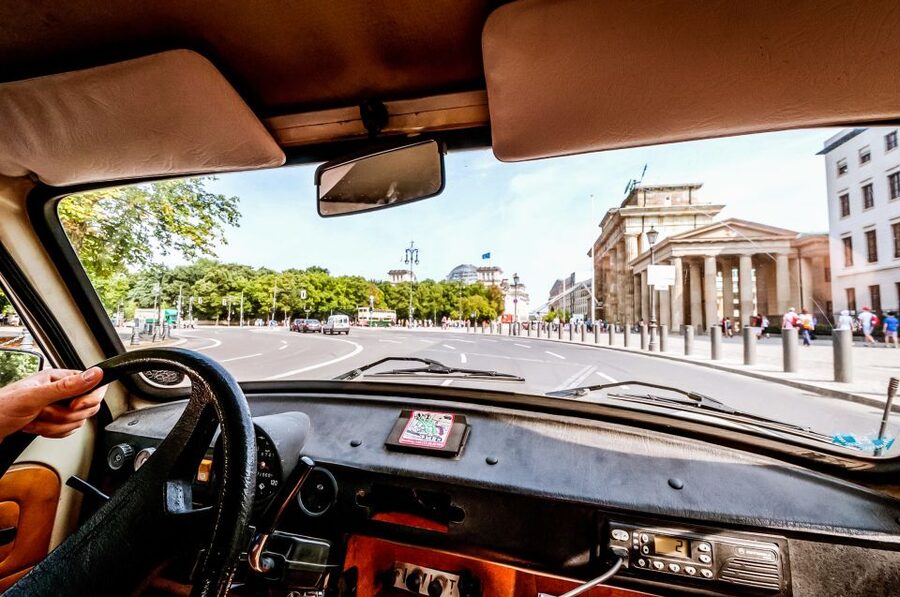
Berlin’s most entertaining history lesson may come with a column-mounted gearstick, a smoky two-stroke engine, and brakes that demand respect. On this 75-minute Trabi Safari, you drive a Trabant through the city in a convoy, passing the Brandenburg Gate, Checkpoint Charlie, the Berlin Wall, and East Side Gallery while a guide talks you through Berlin and the car.
I like two things especially. First, you see the city from inside an actual symbol of former East Germany, not from behind a coach window. Second, the guides, including Thomas, Axel, Harold, and others, mix clear instructions with dry humor and keep the convoy together even when traffic lights split it up. The main drawback is simple: $93 per person is a premium price for a short drive, and the Trabi is cramped, noisy, and not easy for every driver.
Key points to know before you book
- Drive a genuine Trabant: You handle the car yourself after an introduction to its two-stroke engine and unusual manual gearbox.
- See Berlin’s big landmarks: The route passes Potsdamer Platz, Brandenburg Gate, Unter den Linden, Berlin Cathedral, Red City Hall, the TV Tower, East Side Gallery, Oberbaum Bridge, and Checkpoint Charlie.
- Expect a convoy, not a private road trip: Your car is private to your booking, but several other Trabis travel with you.
- Use the radio commentary: Each car has live commentary in English or German, with a guide at the front of the group.
- Plan for a quirky driving lesson: You need a Class B license, must be at least 18, and must be fit to drive.
- Remember the size limit: Each Trabi can carry up to four people or a combined maximum of 330 kilograms.
Why a Trabant is the right Berlin tour vehicle
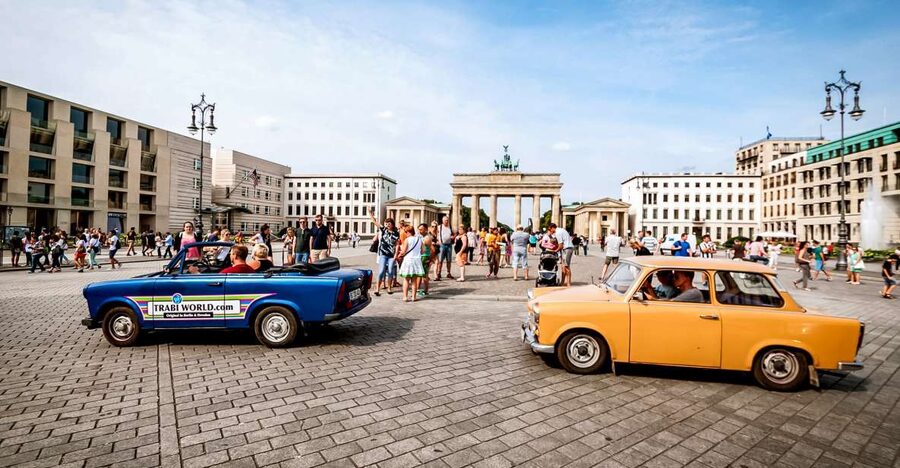
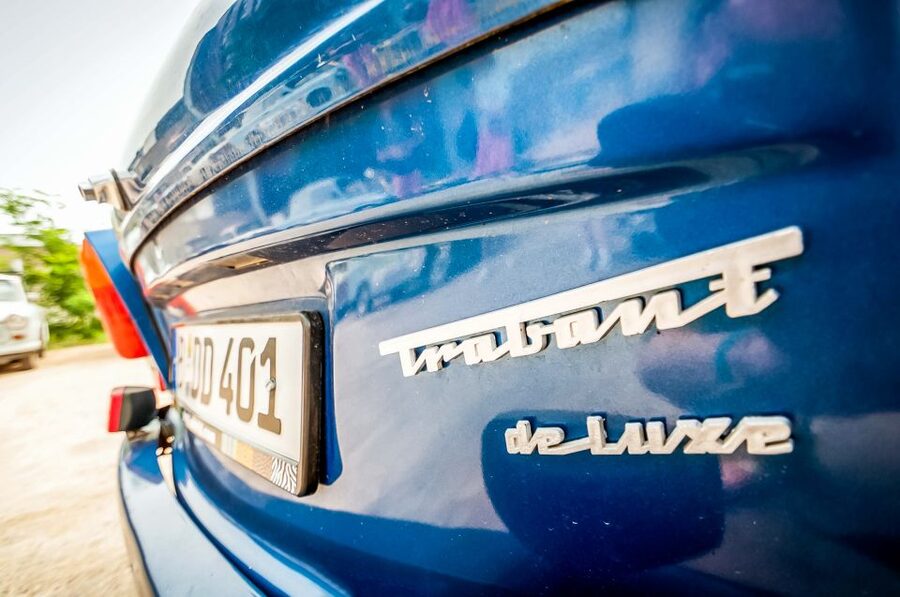
The Trabant, often shortened to Trabi, was the everyday car of East Germany. It was small, basic, and famously slow by modern standards. Its body used duroplast, a hard plastic material, and its two-stroke engine gives the car a distinctive puttering sound.
That history matters here. You are not simply riding in an old car for decoration. You are operating a machine that reflects life in the former German Democratic Republic. The slow pace and clunky controls make Berlin feel different. You notice the streets, the traffic, and the reactions from people on the pavement.
You should also know what you are signing up for. The gearstick sits on the steering column, the car has left-hand drive, and the clutch and braking can take a little getting used to. One driver described the experience as challenging but quickly manageable, while another joked about the hard ride, weak brakes, and fumes. That is part of the appeal for some people, but it is not a luxury-car experience.
If you have not driven a manual car for years, you may need a few minutes to find the rhythm. The staff provide technical instruction before departure, and the guides explain what to do if you fall behind or need help. Some vehicles are automatic, and an electric option has also been available, but you should confirm the vehicle type when booking if this matters to you.
A few more safaris around the world worth a look
- Dubai: Desert Safari, Quad Bike, Camel Ride & Al Khayma Camp
★ 4.9 · 68,962 reviews - Dubai: Desert Safari, Quad Bike, Camel Ride and Sandboarding
★ 4.9 · 43,505 reviews - Dubai: Safari, Quad Bike, Camel Ride, and Buffet Dinner
★ 4.9 · 33,424 reviews
Starting at TrabiWorld on Zimmerstraße
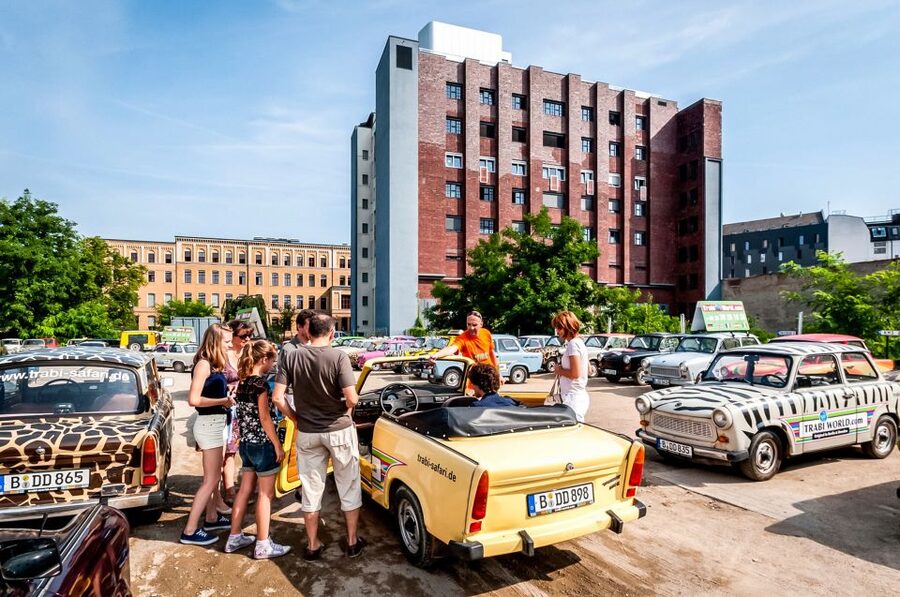
The tour begins at TrabiWorld, at Zimmerstraße 97 to 100, on the corner of Wilhelmstraße. This location puts you close to major central sights, including Checkpoint Charlie, so it fits neatly into a day focused on Berlin’s former Wall zone.
Before setting off, you receive an introduction to the car’s controls and basic mechanics. The guide explains the two-stroke engine, the column shift, the convoy rules, and the communication system. This briefing is important. You do not want your first attempt at the unusual gearbox to happen in the middle of Berlin traffic.
Every booking gets its own car rather than sharing with another booking. A car can hold up to four people, but every participant needs a ticket, including drivers, co-drivers, passengers, and children. Children can receive a free ticket, but they still count toward the permitted number of people in the car.
If two adults want to drive, ask about changing drivers during the tour. The experience includes a stop that allows drivers to swap, giving both people a chance behind the wheel. This is one of the best ways to make the price feel worthwhile.
Learning the controls before Berlin traffic
The first few minutes are the least polished part of the experience, and that is exactly why the briefing helps. A Trabant does not respond like a modern rental car. The column gearshift feels odd at first, and the low-powered engine encourages you to be patient rather than force the car to perform.
The guide leads from the front, while radio commentary reaches each car. The cars are noisy, so clear audio matters. You can listen to explanations about the sights and the Trabant without needing to keep your eyes on a guide’s vehicle.
The convoy system also takes pressure off. Traffic lights may separate the cars, particularly if you are at the back, but the group waits around the next corner and the guide keeps everyone together. This means you can concentrate on driving instead of trying to race through yellow lights or make risky turns to catch up.
Guides such as Thomas, Axel, Harold, and Simon have been praised for combining humor with calm instructions. Their role is more than giving historical facts. They watch the group, help nervous drivers settle in, and keep the tour moving safely through city traffic.
Potsdamer Platz and the route into central Berlin
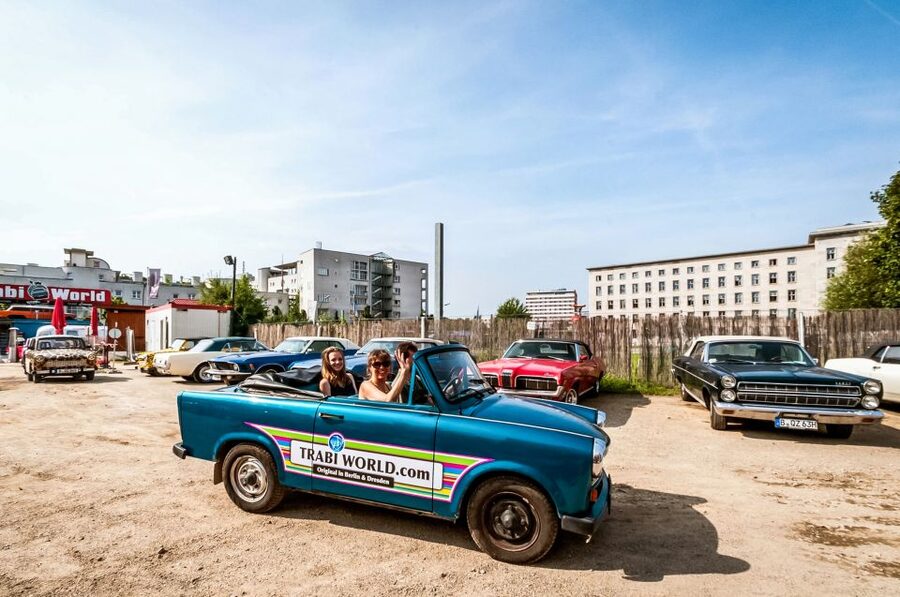
Once the convoy gets moving, Potsdamer Platz gives you a first taste of modern Berlin. The area was divided by the Wall and later rebuilt as a major commercial district. From the seat of a tiny East German car, the contrast between the old vehicle and the modern city around you is hard to miss.
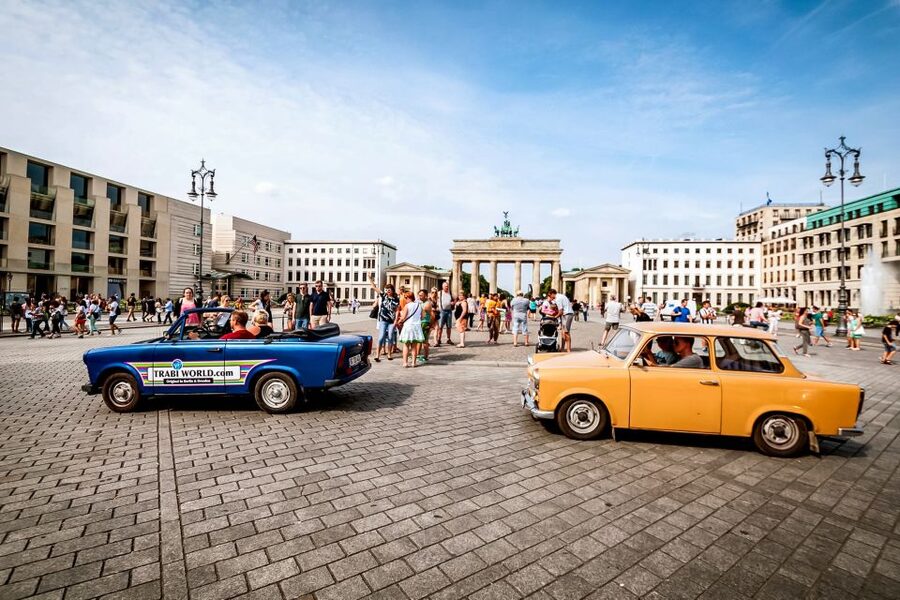
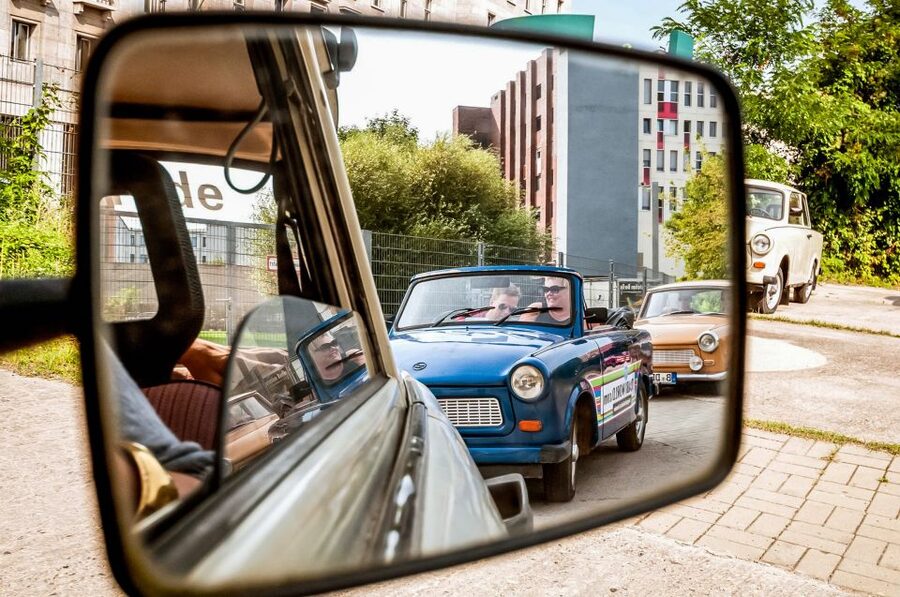
The route continues toward the Brandenburg Gate and Unter den Linden. The gate is one of Berlin’s most familiar sights, but arriving in a line of colorful Trabis changes the usual photo opportunity. You may find people pointing cameras at the cars, waving, or simply watching the convoy putter past.
That attention is part of the experience. You become a moving attraction. It can feel funny and slightly exposed, especially if you prefer to go unnoticed, but most people booking this tour enjoy the playful attention.
Unter den Linden leads into the historic center, where the route includes Berlin Cathedral, the Red City Hall, and the TV Tower. These stops are viewed from the road rather than explored on foot, so you should not book this as a substitute for visiting the buildings inside.
The advantage is coverage. In 75 minutes, you get a useful first look at several parts of central Berlin. If you are new to the city, the route can help you understand how the main areas fit together. One practical tip is to take the Safari early in your stay, so you can use the drive to get your bearings before returning to the sights you want to explore more deeply.
Same country, a different kind of drive:
- Dubai: Red Dune Safari, Quad Bike, Camel Ride, BBQ Dinner
★ 4.9 · 32,185 reviews - Dubai: Premium Safari, Camel Ride & Al Khayma Camp 3-Buffets
★ 4.9 · 30,335 reviews - Dubai: Desert Safari with BBQ Dinner & Quad Biking Options
★ 4.9 · 20,485 reviews - Dubai: Half-Day Desert Safari, Camel Ride, ATV & Dune Buggy
★ 4.9 · 19,221 reviews
The Wall, Checkpoint Charlie, and East Berlin
The strongest part of the route is its connection to Berlin’s divided past. The convoy passes Checkpoint Charlie, one of the best-known former crossing points between East and West Berlin. The modern area is busy and heavily visited, but the location still helps explain how the city was split.
You also pass remaining sections of the Berlin Wall and the murals of East Side Gallery. The artwork turns a former barrier into a long public display, while the Trabi places you directly inside the story of East Berlin rather than viewing it only as a museum subject.
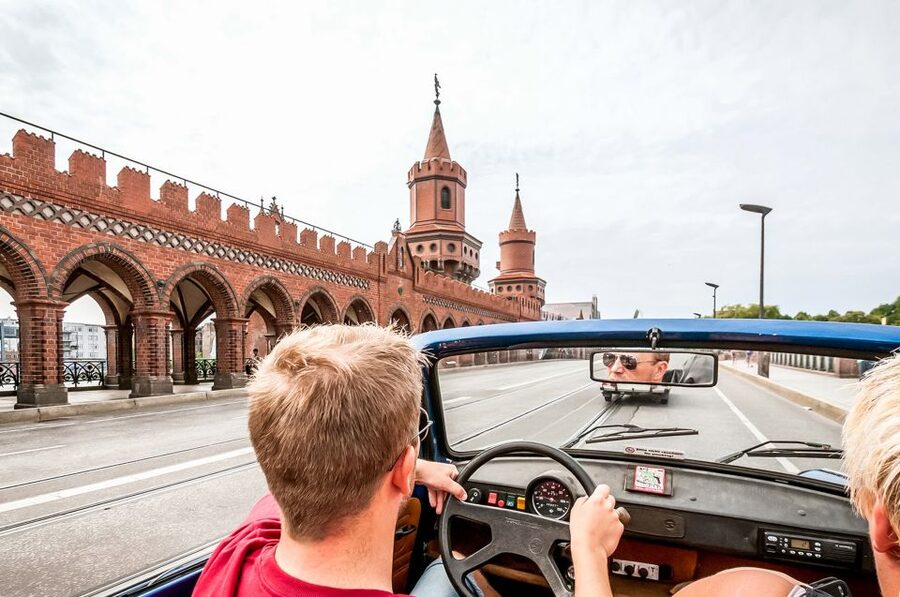
The tour also crosses or passes the Oberbaum Bridge, a striking link between former East and West districts. The bridge and the nearby Wall art make this part particularly photogenic. Guides may stop to take pictures of your group by the Wall artwork and at the Brandenburg Gate, although the exact photo routine can depend on traffic and the day’s conditions.
The route has value because it joins landmarks that are often visited separately. You move from a Cold War checkpoint to a former Wall zone, then toward the modern center, all while driving a car strongly linked with East Germany. That combination gives the tour its identity.
Still, keep your expectations in check. The commentary provides context, but the drive is not a full historical walking tour. You will hear about what you pass, then continue on. For detailed history, pair it with a museum, a Wall memorial, or the Trabi Museum at TrabiWorld.
What the drive feels like in practice
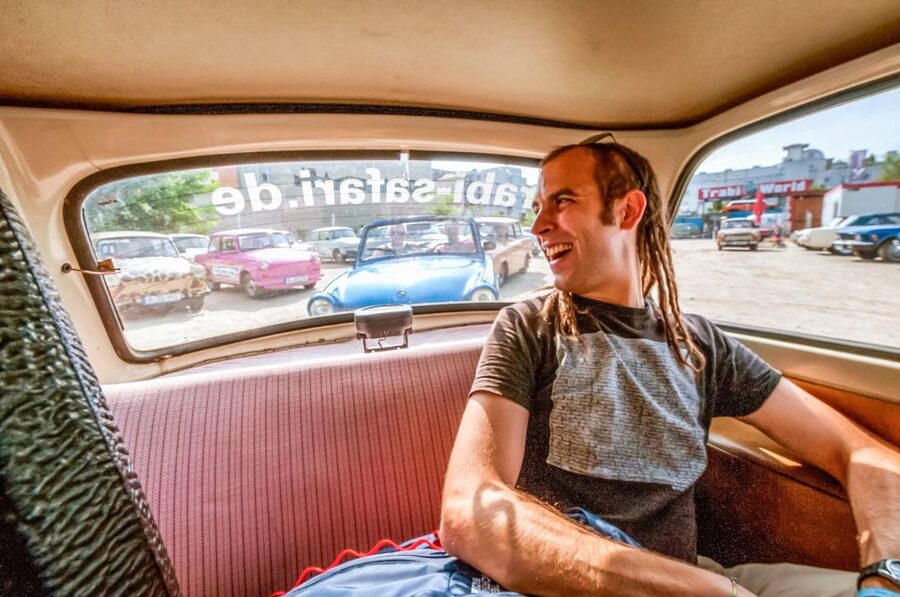
The Trabi is small. Four people are allowed, but four adults may find the cabin tight, especially if anyone is tall. A family with teenagers reported that two very tall passengers had to arrange themselves awkwardly in the back. If you are around 1.8 meters or taller, think carefully about who sits where.
The car is also noisy and can be rough over cobblestones. That makes the ride memorable, but it can make conversation difficult without the radio system. You may also notice engine noise and exhaust inside the cabin. This is an old vehicle, not a restored touring limousine.
Driving is usually the central pleasure. You get the chance to handle the car rather than simply pose beside it. The low power means you are not speeding between sights, and the convoy keeps the pace controlled. You may reach fourth gear on faster stretches, but much of the tour is a slow city drive.
The experience can feel nerve-racking at first, particularly if you are used to right-hand-drive roads or modern automatic cars. It becomes easier once you understand the shift pattern and clutch. If you are nervous, tell the staff before departure. The guides are used to helping first-time Trabi drivers, and the convoy waits if someone needs extra time.
You need a valid driver’s license, must be at least 18, and must hold a Class B license. You also need to be fully fit to drive. A co-driver or passenger does not remove the need for each participant to have a ticket, so check the booking details for your whole group.
Is $93 per person a fair price?
At $93, this is expensive compared with a standard sightseeing bus. You cover fewer sights in 75 minutes, and the vehicle is not comfortable in the usual sense. If your only goal is to collect photographs of Berlin landmarks, cheaper options exist.
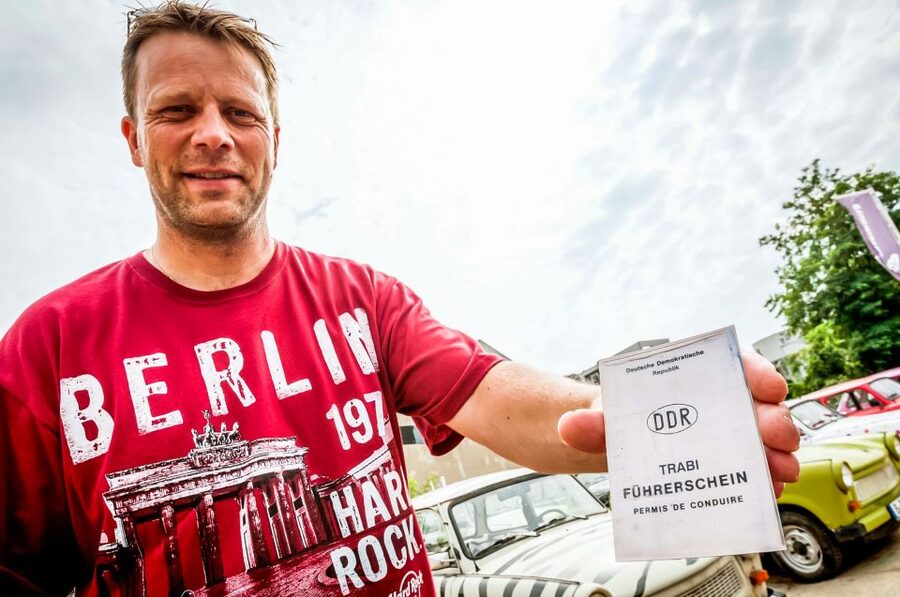
The value comes from the driving and the setting. You receive technical instruction, fuel and mileage, a guide at the head of the convoy, live radio commentary, and a Trabant driver’s license as a souvenir. Third-party vehicle damage insurance is included, but it carries a deductible of 850 euros, so read the terms carefully before driving.
I would see the price as reasonable for someone who specifically wants to drive a historic East German car. It is less convincing for a passenger who only wants a city tour. If your group has two people who want to drive, the chance to swap halfway improves the value.
The experience also works well for families with older children, car enthusiasts, history fans, and anyone who wants something less conventional than a walking tour. It may not suit people who dislike manual gearboxes, cramped seating, noisy vehicles, or public attention.
When to go and how to fit it into your day
A Sunday can be a good choice because lighter traffic may make the driving less stressful, though the tour runs in normal city conditions and traffic is never fully predictable. Allow time before the start to reach TrabiWorld and complete the briefing. Arrival costs are not included.
I would schedule the tour early in a Berlin visit if you want a quick orientation. You will pass many major sights and learn the broad shape of central Berlin. If you already know the city well, the value is less about seeing new places and more about seeing familiar streets from an unusually slow, noisy seat.
Afterward, consider visiting the Trabi Museum at TrabiWorld. It gives you a closer look at the car and its place in East German life. You can also return to the Wall sites, Brandenburg Gate, or Checkpoint Charlie on foot, when you have time to stop and read the displays.
Free cancellation is available up to 24 hours before departure, and you can reserve now and pay later. Starting times vary, so check availability for your chosen date.
My advice on booking the Trabi Safari
Book this if you want to drive, not simply ride. The best part is the strange pleasure of learning an old car, joining a convoy, and seeing Berlin react as you pass. The guides add real value, especially when they combine practical help with humor and keep nervous drivers from feeling stranded.
Think twice if you need roomy seating, a quiet ride, or a detailed stop-by-stop history tour. The Trabi is cramped and imperfect by design, and the $93 cost includes a fair amount of novelty.
For the right person, this is one of Berlin’s most memorable short activities. You get a city overview, a lesson in East German motoring, a few excellent photo opportunities, and a souvenir license that feels more fitting than a standard postcard.
FAQ
How long does the Berlin Trabi Safari last?
The experience lasts 75 minutes. Check the available starting times for your chosen date.
Where does the tour begin?
It begins at TrabiWorld, Zimmerstraße 97 to 100, at the corner of Wilhelmstraße in Berlin.
Do I drive the Trabant myself?
Yes. After technical instruction on the two-stroke engine and gearbox, you drive your own Trabi as part of the convoy.
What driving license do I need?
You must be at least 18 and hold a Class B driver’s license. You must also be fully fit to drive.
Can two people share the driving?
Yes. A stop during the tour allows drivers to swap, so two adults can each have a turn behind the wheel.
How many people fit in one Trabant?
Each car can carry a maximum of four people or a combined maximum weight of 330 kilograms, or 727 pounds.
Is commentary available in English?
Yes. The tour is available in English and German, with a live guide at the front and radio commentary in each car. Audio commentary is also available in English and German.
What is included in the price?
The experience includes technical instruction, a convoy guide, live radio commentary, fuel and mileage, and a Trabant driver’s license. Third-party vehicle damage insurance is included with an 850 euro deductible.
Just added around the world
- Dubai Desert Safari With BBQ dinner★ 5.0 · 15 reviews
- Dubai Private Morning Desert Safari: Camel Ride & Sandboarding★ 5.0 · 19 reviews
- Deluxe Premium Dubai Desert Safari with Camel Ride, and Live Show★ 5.0 · 82 reviews
- Premium Deluxe Dubai Safari with Camel Ride, Sandboard & BBQ★ 5.0 · 55 reviews
- Dubai Morning Desert Safari: Camel Ride & Sandboarding!★ 5.0 · 116 reviews
- Camel Trekking and Morning Safari with Sand Boarding★ 5.0 · 19 reviews
- Thrilling Desert Safari Dubai Adventure with Sand Boarding and Barbecue Dinner★ 3.5 · 30 reviews
- Dubai Desert Safari★ 4.5 · 15 reviews