
REVIEW · NEW DELHI
Private 4-Day Golden Triangle Tour with Ranthambore Tiger Safari
The big draw here is the mix: Mughal monuments, Jaipur palaces, and a Ranthambore tiger safari in one tightly packed trip. You move by private air-conditioned car, with local guides at the major sights and a driver who stays with you from Delhi through the final return.
I like the personal setup, especially the freedom to adjust the sightseeing plan and the fact that your own family or friends form the tour group. I also like the useful Old Delhi rickshaw ride, which gets you into the narrow lanes around Chandni Chowk without asking your driver to squeeze a car through them.
The catch is simple: India is large, and the road time is substantial. You may spend several hours in the car on some days, and the $230 starting price does not include about $180 per person in monument entry fees.
Key points to know before booking
- Old Delhi by rickshaw: See Jama Masjid, Chandni Chowk, and the lanes around the old Mughal capital without tackling the traffic on foot.
- A private road journey: Your car, driver, and sightseeing schedule are private, but the Ranthambore safari is shared.
- A sunrise Taj Mahal visit: The early start gives you the best chance of cooler air and softer light, with about two hours inside the monument area.
- A real wildlife gamble: Ranthambore gives you a chance to look for Bengal tigers, but the zone, vehicle, and animal sightings are not guaranteed.
- Three different hotel nights: The tour includes stays in Agra, Ranthambore, and Jaipur, with 3, 4, or 5-star options depending on the package.
- A full final day: Jaipur sightseeing is followed by a return to Delhi, with arrival expected around 9 p.m.
Why this four-day route works
The Golden Triangle links Delhi, Agra, and Jaipur, three cities that show very different sides of northern India. Adding Ranthambore changes the rhythm. You are not only moving from fort to palace, but also setting aside time for wildlife.
That variety is the main reason to consider this package. Day one begins in Delhi, day two combines Agra with the transfer toward Ranthambore, day three brings the safari and Jaipur, and day four covers Jaipur before the long drive back to Delhi.
You should think of this as an efficient introduction, not a slow cultural stay. It covers a great deal in four days. The reward is range. The cost is time in the car and early mornings.
The private format helps. You can ask to add, remove, or change monuments after booking, and your guide and driver remain with your group rather than sending you between unrelated shared excursions. For first-time visitors, that can make a complicated route easier to manage.
A few more safaris around India worth a look
- 4 Day Golden Triangle with Ranthambore Tiger Safari Tour from Delhi
★ 5.0 · 110 reviews - From Delhi: 4-Day Golden Triangle & Ranthambore Tiger Safari
★ 4.8 · 47 reviews - 4 Days Group Camping Safari
★ 5.0 · 1,101 reviews
Day one: Jama Masjid, Chandni Chowk, and Old Delhi by rickshaw
Your first morning introduces you to Old Delhi, beginning with Jama Masjid. Built by Mughal emperor Shah Jahan between 1650 and 1656, this large mosque gives you an early sense of the scale and ambition of Mughal Delhi. Allow about an hour, and remember that the entry charge is not included.
Next comes Chandni Chowk, the old commercial center. The area is known for spices, dried fruit, silver jewelry, and colorful saris. It is crowded, noisy, and full of narrow lanes, which is exactly why the rickshaw ride is useful.
The 30-minute rickshaw outing gives you a close view of the old quarter without requiring a long walk through traffic. It also connects the modern city to the history of Shahjahanabad, the capital founded when Shah Jahan moved his court in 1638.
The Red Fort follows. This enormous Mughal fortress served as the home of Mughal emperors for nearly two centuries, until 1856. The schedule allows only about 30 minutes here, so you should treat it as a brief exterior or focused stop rather than a full museum visit. The fort’s monument entry is not included.
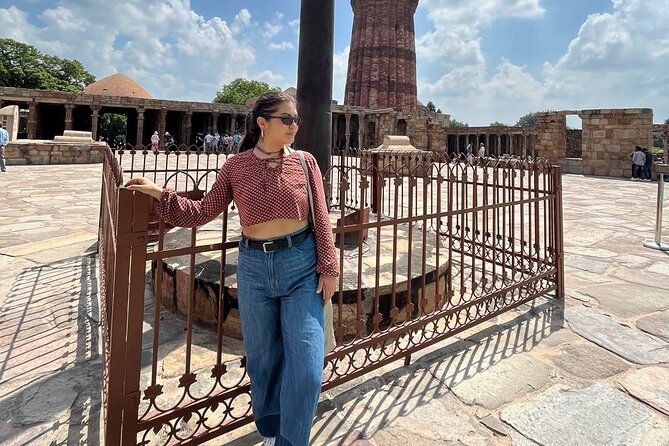
Qutub Minar provides a different chapter of Delhi’s past. The UNESCO-listed tower was begun in 1193 by Qutub-ud-din Aibak, founder of the Delhi Sultanate. You have about an hour here, and the entry fee is extra. The site is worth your time for the tower itself and the surrounding remains, but comfortable shoes will help.
The Lotus Temple is a shorter stop, about 30 minutes, and admission is free. Its flower-shaped design gives you a break from the older stone and sandstone monuments. India Gate, another free stop, is a war memorial honoring soldiers of British India who died in war.
You will also drive past Parliament House and Rashtrapati Bhavan, the President’s residence. These are mainly viewing stops rather than long interior visits, but they help you read Delhi as both an imperial capital and the seat of modern government.
Agrasen Ki Baoli is one of the more unusual stops. This protected stepwell has a quiet, geometric design and takes about 15 minutes to see. It is a quick visit, but the change from grand boulevards and giant monuments is welcome.
After lunch near the Yamuna Sports Complex, you drive to Agra by expressway. The transfer is listed at about three hours, though traffic can change the timing. You then check into your Agra hotel for the night.
Day two: Taj Mahal at sunrise and Agra Fort
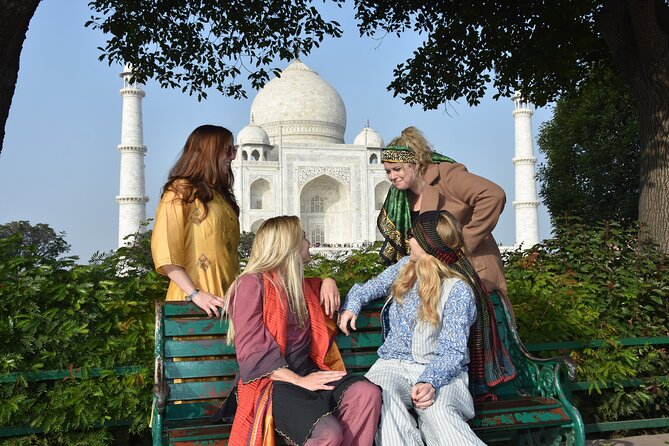
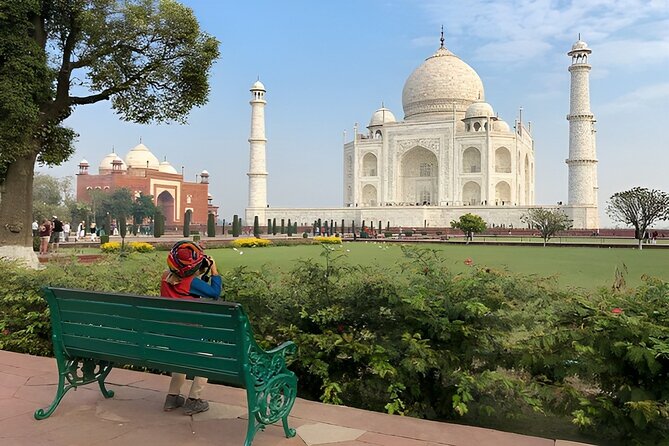
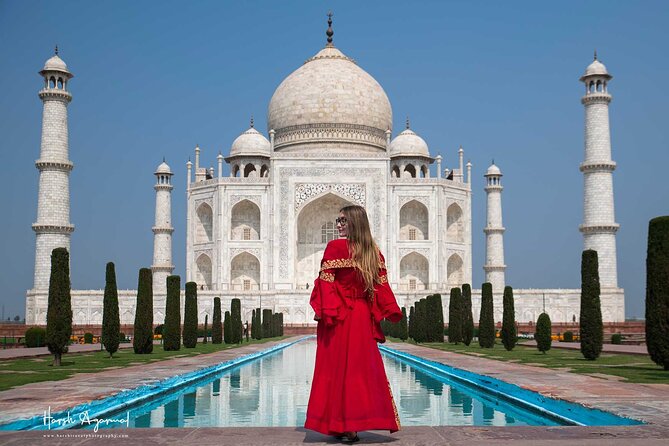
The Taj Mahal is the emotional center of the trip, and the early start is sensible. You visit around sunrise and spend roughly three hours at the site, including a guided visit inside the main monument area. The entry fee is separate.
The Taj is famous for its white marble, but your guide can help you notice the details that photographs miss: the balance of the building, the changing color of the marble, and the way the complex is arranged around the central tomb. Guides such as Shan have been praised for adding small details and making the explanation feel more like a story than a list of dates.
Your timing matters. The sunrise visit avoids some of the day’s heat, but you will need to get up early. The Taj Mahal is closed every Friday, so the route changes if your tour begins on Thursday. In that case, the order becomes Delhi, Jaipur, Ranthambore, Agra, and Delhi.
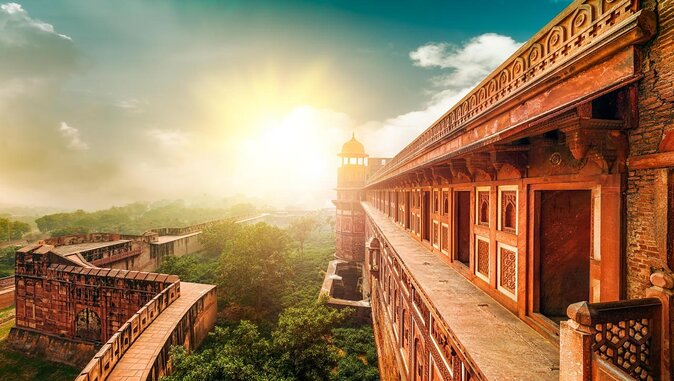
Agra Fort comes next, with about an hour for the visit. This UNESCO site was both a military stronghold and a royal residence. Your guide will explain the fort’s different courtyards and buildings, and the views toward the Taj Mahal add another reason to keep your camera ready.
The day then turns into a long transfer to Ranthambore National Park. The schedule allows about four hours for the journey and hotel arrival. You check in, have free time, and receive one dinner at the hotel as part of the package.
This is one of the least glamorous parts of the route. You are moving between major destinations rather than sightseeing continuously. Still, the private vehicle means you can settle into your own space, carry water, and ask for reasonable comfort stops as needed.
Day three: Ranthambore safari and the road to Jaipur
The Ranthambore safari starts early, with two to three hours inside the park. You travel in a shared jeep or canter with a government-appointed guide while looking for wild Bengal tigers.
Keep your expectations sensible. A safari is a search, not a scheduled animal appearance. The government assigns the safari zone according to availability, so you cannot choose the exact area you will visit. The operator aims to arrange a shared jeep, but limited jeep availability can mean a larger shared canter instead.
The safari guide speaks English, though fluent English may not always be available. You should expect basic explanations about the park and wildlife rather than a polished private lecture. The shared vehicle also means less control over stops and seating.
Even with those limits, Ranthambore adds something the usual Golden Triangle route does not. You are out early, away from the monuments, scanning the forest for movement. The experience depends on luck, patience, and the quality of the sighting on that day.
After the safari, you travel to Jaipur and check into your hotel. The listed transfer and arrival period takes about three hours, with the rest of the day free. That free time matters because the first three days are demanding.
The Ranthambore hotel options include a 3-star property such as Hotel Ranthambore Tiger Resort or a similar hotel, with higher-category choices available depending on the package. Ask exactly which property and room category applies before paying, since the descriptions use similar wording rather than promising one fixed hotel.
Same country, a different kind of drive:
- Non-Touristic overnight Camel Safari
★ 5.0 · 526 reviews - Overnight Camel Safari – Sleeping under the Stars
★ 5.0 · 390 reviews - Adventure non touristic camel safari
★ 5.0 · 300 reviews - Overnight Desert Safari Tour Package
★ 5.0 · 255 reviews
Day four: Jaipur’s forts, palaces, and astronomical instruments
Jaipur’s final day begins at Panna Meena ka Kund, an architectural stepwell near Amber. The stop is short, about 20 minutes, but the symmetrical stairways make it a worthwhile photo stop and a good introduction to the area’s water architecture.
Amber Fort receives about two hours, the longest visit of the morning. This UNESCO-listed fort combines courtyards, gateways, painted decoration, and broad views across the surrounding hills. Entry is not included, so your guide can help you buy the ticket and avoid waiting at the ticket counter.
Jal Mahal follows. The palace sits in Man Sagar Lake, and the usual visit is a 30-minute viewing stop. You do not need much time here. The building is mainly appreciated from the lakeside, where its position in the water gives you a sharp change from the crowded fort interiors.
The City Palace takes about two hours and offers a closer look at Jaipur’s royal administration and ceremonial life. The complex now contains the Maharaja Sawai Man Singh II Museum. Again, the monument fee is extra.
Jantar Mantar is one of Jaipur’s most distinctive sights. Built in 1734, this UNESCO site contains 19 large astronomical instruments commissioned by Sawai Jai Singh II. Your guide can explain how the structures track time and celestial movement. It is far more rewarding when you understand what the instruments were designed to do, so this is a stop where a good guide matters.
Hawa Mahal, or the Palace of Winds, is a 30-minute stop. Its red and pink sandstone facade is made for photography, especially from the street. The visit is brief, so do not expect a long palace tour here.
The final stop is Gaitore Ki Chhatriyan, a royal cremation site with carved cenotaphs in the Rajput style. It is a quieter ending than the City Palace or Hawa Mahal, and half an hour is enough for a look around.
After Jaipur, you return to Delhi. Arrival is expected around 9 p.m., though the operator can adjust the timing if you prefer an earlier or later return. Traffic is the main unknown, so avoid scheduling a flight or fixed evening plan too close to the expected arrival.
The private car, guides, and hotel choices
The vehicle depends on group size. One or two people use a three-seat sedan such as a Toyota Etios or similar. Groups of three to five use a six-seat wagon such as a Toyota Innova, while six to ten people travel in a 10-seat Tempo Traveler.
Your driver handles the long connections, while separate local guides lead the sightseeing in Delhi, Agra, and Jaipur. Drivers such as Amar and Bilal have been praised for safe, comfortable journeys, and guides including Aamir, Faisal, Sonny, Isha, Ali, Saif, and Sandeep have been associated with the operation.
You can choose 3, 4, or 5-star accommodation. The named examples include Hotel Taj Vilas or similar in Agra, Hotel Ranthambore Tiger Resort or similar near the park, and Hotel 7 Apple or a similar Jaipur property. Breakfasts are included, along with one hotel dinner.
Rooms are normally arranged on a twin-sharing basis. Three people generally share a triple room unless you pay extra for two rooms. If you choose the package without hotels, you can select your own properties, with the first night in Agra and the second night in Jaipur.
What the $230 price really covers
At $230 per person, the starting price looks low for a private four-day route with three hotel nights, a private car, fuel, driver, local guides, breakfasts, the rickshaw ride, and a safari. But you need to add the listed monument fees of about $180 per person when judging the real cost.
That puts the stated base and entry charges at about $410 per person, before any other personal spending. The value depends on what you would otherwise pay for three hotel nights, intercity transport, several private guides, and the safari separately.
The private format is a strong point for families and small groups. You avoid joining a large road tour, can request itinerary changes, and have help buying monument tickets. The main compromise is that the wildlife portion is not private, and the hotels may vary by category and availability.
Who should book this route
I would recommend it to a first-time visitor who wants the major sights without arranging several Indian train rides, hotel transfers, guides, and park permits alone. It also suits families and small groups that value a private car and a flexible sightseeing plan.
You should be comfortable with early starts, long drives, heat, crowds, and a packed schedule. If you want slow mornings, extended time in each palace, or a strong chance of seeing a tiger, four days may feel rushed and the safari may disappoint.
Check the start date carefully. Avoid a Thursday start if the original order is important to you, since the Taj Mahal is closed Friday. Also confirm the hotel category, room arrangement, safari vehicle, and full monument charges before booking.
Should you book it?
Book this tour if your priority is range: Delhi’s old lanes, the Taj Mahal, Agra Fort, a tiger safari, and Jaipur’s forts and palaces in one organized trip. The private driver and local guides remove much of the planning work, and the option to adjust the route gives you useful control.
Skip it if you dislike long road transfers or want a relaxed wildlife holiday. For most first visits, though, the package offers a practical way to see a remarkable amount of northern India in four days, as long as you budget for the extra monument fees and accept that the tiger sighting is never promised.
FAQ
Is this tour private?
Yes. The transport, driver, and sightseeing are private for your group. The Ranthambore safari is shared in a jeep or canter.
Are hotels included?
Yes, three nights with breakfast are included when you select an accommodation package. You can choose among 3, 4, or 5-star options. A package without hotels is also available.
Are monument entrance fees included?
No. Monument entry fees are listed separately at about $180 per person. Guides can assist you with buying tickets at the sights.
Is the Taj Mahal open every day?
No. The Taj Mahal is closed every Friday. If you start on Thursday, the route changes to Delhi, Jaipur, Ranthambore, Agra, and Delhi.
What happens if a shared jeep is not available at Ranthambore?
The operator tries to arrange a shared jeep, but a shared canter may be used because safari vehicles are limited. The safari zone is assigned by the government based on availability.
When do you return to Delhi?
The planned return on day four is around 9 p.m. The timing can be adjusted if you prefer to arrive earlier or later, but traffic affects the exact arrival time.
Just added around India
- Wild Life Jeep Safari Tour at Bannerghatta with Private Transfer★ 5.0 · 24 reviews
- Sariska Tiger Reserve Assistance for Gypsy Private Safari Tickets★ 4.0 · 13 reviews
- Chambal River Safari★ 5.0 · 75 reviews
- Sanjay Gandhi National Park + Kenheri Caves + Lion Safari★ 4.4 · 19 reviews
- Ranthambore National Park: Safari Ticket with Pickup Option★ 4.5 · 32 reviews
- Sawai Madhopur: Ranthambore National Park Guided Jeep Safari★ 4.4 · 23 reviews
- Peeps Billions of Star Experience with Desert & Camel Safari★ 4.8 · 18 reviews
- Nomadic Non-Touristic Overnight Camel & Desert Safari Tour★ 5.0 · 56 reviews
New Delhi Safaris, compared.

4 Day Golden Triangle with Ranthambore Tiger Safari Tour from Delhi
Read our review →
Old Delhi Food Tour Safari – The Capital of Flavors
Read our review →
From Delhi: 5-Day Tiger Safari & Golden Triangle Tour
Read our review →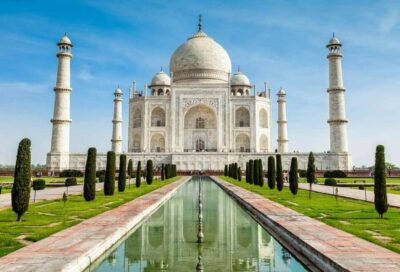
Delhi Agra Jaipur Golden Triangle Multiday Trip with Safari
Read our review →
From Delhi: 4-Day Golden Triangle & Ranthambore Tiger Safari
Read our review →
From Delhi: 5 Day Golden Triangle, Safari, & Bird Sanctuary
Read our review →Browse the lists this tour appears in